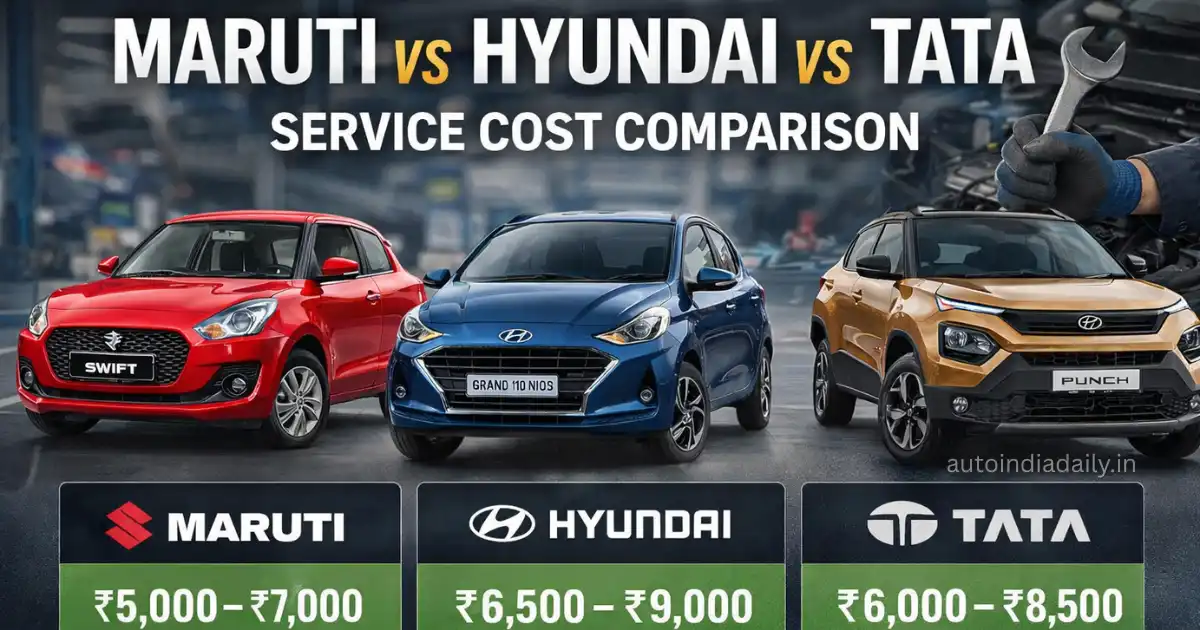
Maruti vs Hyundai vs Tata service cost comparison is an important factor for many car buyers. In India’s highly price-sensitive automobile market, the cost of owning a vehicle goes far beyond the showroom price. For many buyers, especially first-time owners and budget-conscious families, long-term maintenance costs play a decisive role in choosing a car brand.
Routine servicing, spare part pricing, labor charges, and the accessibility of service centers can significantly influence the total cost of ownership (TCO).
Among mainstream mass-market manufacturers, Maruti Suzuki, Hyundai, and Tata Motors consistently dominate the sales charts. However, their ownership experiences differ when it comes to servicing and maintenance costs.
While Maruti Suzuki has historically maintained a strong reputation for affordability and low running costs, Hyundai positions itself with refined service experiences and modern technology, and Tata Motors has been strengthening its reliability and service strategies in recent years.
Based on recent industry estimates and ownership data from 2025–2026, this analysis compares the maintenance economics of these three major brands and examines what the numbers mean for Indian buyers.
Average Annual Service Cost Comparison: Maruti vs Hyundai vs Tata
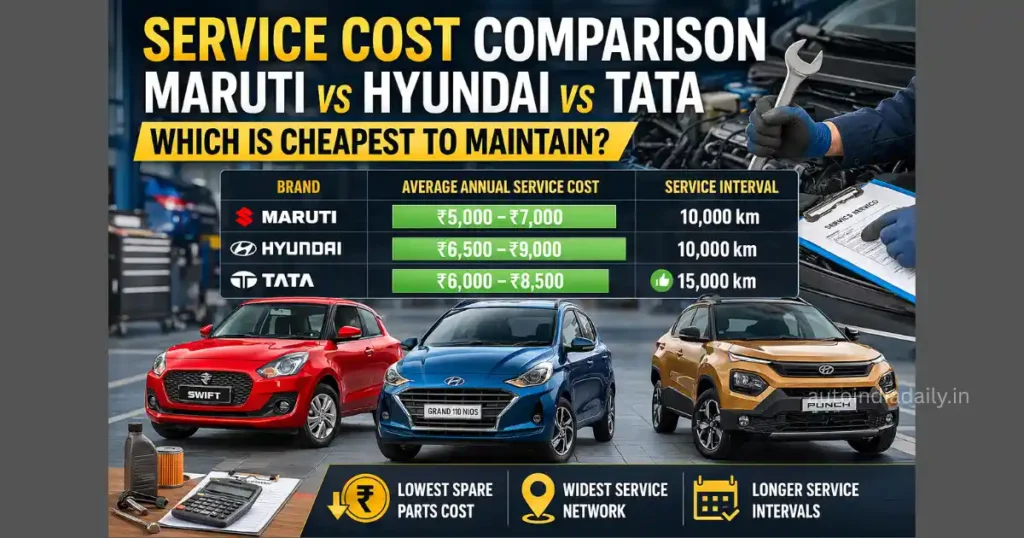
A useful starting point in evaluating maintenance affordability is the average annual service cost. While the exact amount depends on driving habits, fuel type, and the model chosen, broad industry estimates provide a general comparison.
| Brand | Avg. Annual Service Cost (₹) | Key Maintenance Highlights |
|---|---|---|
| Maruti Suzuki | ₹5,000 – ₹7,000 | Lowest spare part costs; largest service network |
| Tata Motors | ₹6,000 – ₹8,500 | Longer 15,000 km service intervals |
| Hyundai | ₹6,500 – ₹9,000 | Initial services often labor-free |
From the numbers alone, Maruti Suzuki remains the most economical brand to maintain on average, though the gap has gradually narrowed as Tata Motors and Hyundai introduce competitive service packages and extended intervals.
However, the broader story lies in why these differences exist and how manufacturer strategies influence ownership costs.
Maruti Suzuki: Consistently the Most Affordable
Maruti Suzuki’s reputation for low maintenance costs is deeply tied to its long-standing approach to manufacturing, component sharing, and service accessibility.

Extensive Parts Ecosystem
One of the biggest contributors to Maruti’s lower service cost is the affordability of Maruti Genuine Parts (MGP). Because the company shares components across a wide range of models, spare part production happens at large scale, reducing manufacturing costs.
For example, engines such as the K-Series petrol engine family are used across several vehicles. This parts commonality reduces inventory complexity and ensures spare components remain widely available.
The result is that replacement parts — from filters to brake components — tend to be cheaper than equivalents from many competitors.
Standout Low-Maintenance Models
Certain entry-level models further reinforce Maruti’s cost advantage.
The Maruti Suzuki Alto K10 and Maruti Suzuki Wagon R are often cited among the lowest maintenance cars in India. Annual service costs for these models can drop to approximately ₹3,000–₹3,600, depending on driving conditions and usage patterns.
These vehicles also benefit from simple mechanical architecture, which typically reduces the frequency of expensive repairs.
Also Read: Maruti Suzuki March 2026 Offers: Up to ₹50,000 Discount on Swift, Brezza, Wagon R
Largest Service Network in India
Another major advantage is Maruti Suzuki’s unmatched service network.
With thousands of authorized service centers across India, including smaller towns and rural areas, Maruti owners often find servicing more accessible and competitively priced. Local availability reduces logistics costs for spare parts and increases competition between service providers.
For buyers outside major urban centers, this factor alone can significantly influence brand preference.
Impact on Resale Value
Low maintenance costs also contribute to higher resale value, an important aspect of the ownership lifecycle.
Cars that are inexpensive to maintain tend to attract more buyers in the used-car market. As a result, many Maruti models retain a higher percentage of their original value compared with competitors in the same price bracket.
This combination of low servicing cost + strong resale demand strengthens the brand’s long-term ownership appeal.
Hyundai: Balanced Ownership With Premium Touch
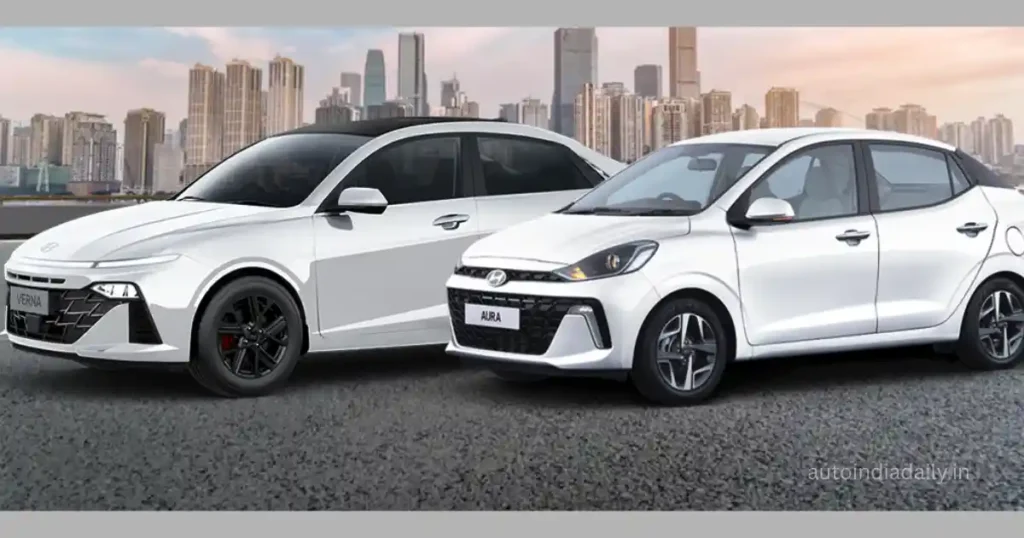
Hyundai has traditionally positioned itself slightly above Maruti in terms of perceived quality and features. This positioning influences both its service experience and maintenance costs.
Transparent and Structured Service Programs
Hyundai dealerships are widely known for their structured service processes and transparent pricing models. Many models come with service cost calculators and pre-defined maintenance schedules, allowing owners to estimate expenses in advance.
Additionally, Hyundai frequently offers labor-free servicing for the first two or three scheduled services, which helps reduce initial ownership costs.
This strategy makes the early ownership phase comparatively affordable, though labor charges may increase later in the vehicle’s life cycle.
Slightly Higher Spare Part Costs
Compared with Maruti Suzuki, Hyundai does not rely as heavily on cross-model component sharing. As a result, spare parts for Hyundai vehicles may be slightly more expensive, particularly for newer models equipped with advanced infotainment systems or driver assistance features.
However, the difference in cost is often offset by Hyundai’s focus on reliability and lower repair frequency.
Popular Models With Competitive Maintenance
Despite being positioned as a more premium alternative, certain Hyundai models remain relatively economical to maintain.
Vehicles such as the Hyundai Grand i10 Nios and Hyundai Venue can deliver average maintenance costs of around ₹3,200 annually for petrol variants during the first five years, depending on service plans and driving patterns.
This places them within competitive range of many Maruti models, especially in urban ownership scenarios.
Also Read: Upcoming Hyundai EVs in India: Ioniq 5 Facelift in Q2 2026, Compact EV Planned
Urban-Focused Service Presence
Hyundai has a strong service presence across India but remains more concentrated in urban and semi-urban areas compared with Maruti.
For metropolitan buyers, Hyundai’s service infrastructure offers convenience and modern facilities. However, in smaller towns, the network may not match the same level of accessibility as Maruti Suzuki.
This difference can sometimes influence ownership decisions among rural or tier-3 city buyers.
Tata Motors: Improving Reliability and Longer Intervals
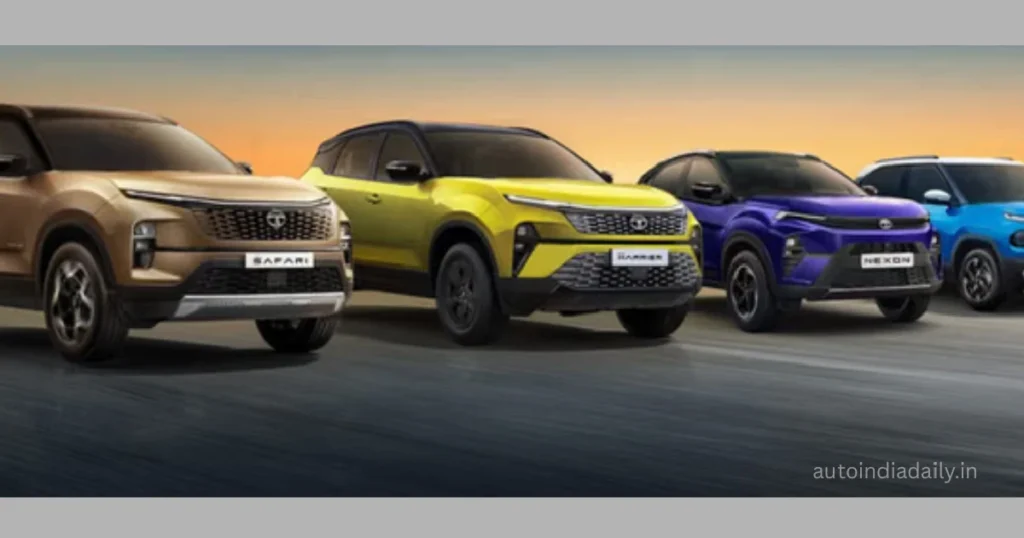
Over the past decade, Tata Motors has undergone a significant transformation. The brand has improved vehicle design, build quality, and reliability, particularly with newer platforms used in its latest generation of cars and SUVs.
These improvements have also influenced maintenance patterns.
Longer Service Intervals
One of Tata’s distinctive service advantages is its 15,000 km service interval, which is longer than the industry-standard 10,000 km interval used by many competitors.
For owners who drive frequently or cover high annual mileage, this extended interval reduces the number of service visits required.
While individual service costs may be slightly higher, fewer service appointments can help balance the total maintenance expenditure over time.
SUV-Focused Lineup
Tata Motors’ lineup is heavily focused on SUVs and crossovers, which generally have slightly higher maintenance costs than entry-level hatchbacks.
However, models like the Tata Punch have shown that Tata can deliver competitive ownership economics.
The Punch reportedly averages around ₹4,800 per year in service costs while covering up to 75,000 km over five years — a distance that can exceed what some competitors cover under comparable maintenance schedules.
Also Read: Tata Punch EV vs Petrol: Which Is Better to Buy in 2026? Price, Cost & Comparison
Improved Build Quality and Reliability
In earlier years, Tata vehicles were sometimes associated with higher running repairs. However, recent models built on newer architectures have demonstrated significant improvements in reliability and durability.
Better structural engineering and higher-quality components mean fewer unscheduled repairs, which helps stabilize long-term ownership costs.
As reliability improves, Tata’s maintenance cost gap with competitors continues to narrow.
Also Read:
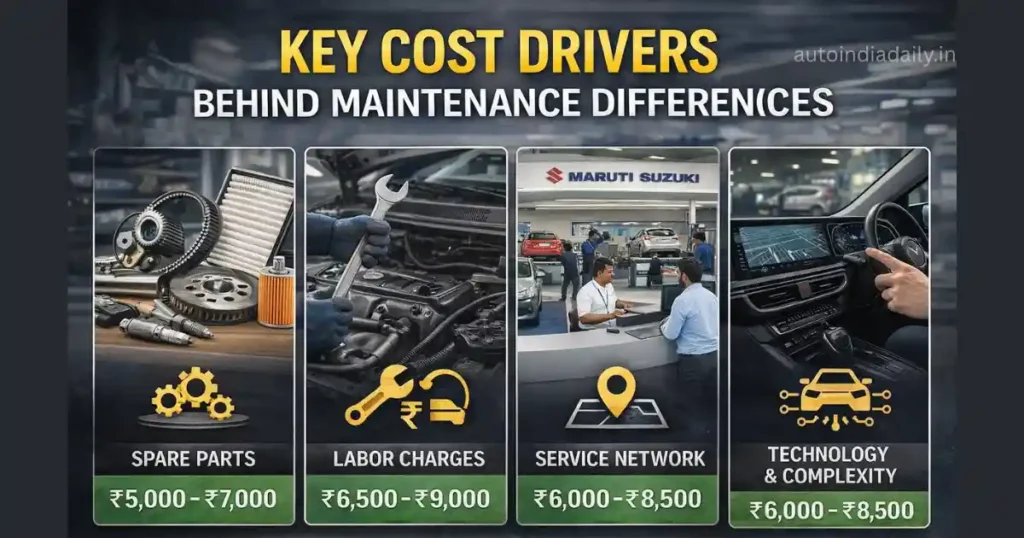
Key Cost Drivers Behind Maintenance Differences
Maintenance costs are influenced by several structural factors beyond basic service pricing.
Understanding these factors helps explain why certain brands consistently remain cheaper to maintain.
Spare Parts Pricing
Spare parts form a large portion of maintenance costs over a vehicle’s lifespan.
Maruti Suzuki benefits from its large domestic manufacturing ecosystem, which keeps the price of commonly replaced components low.
Hyundai’s parts, while reliable, often cost slightly more due to model-specific designs and higher technology integration. Tata’s parts pricing typically sits between the two depending on the vehicle segment.
Labor Charges
Labor costs vary between manufacturers and service locations.
Hyundai’s strategy of initial labor-free services reduces early ownership costs, but labor charges may increase later.
Maruti’s widespread service network creates price competition between service centers, which can help keep labor charges relatively low.
Tata’s labor charges vary depending on the complexity of the vehicle and the type of service required.
Service Network Reach
Service accessibility directly affects maintenance costs.
A large network means parts availability is higher and waiting times are shorter. Maruti Suzuki’s extensive coverage across India gives it a major advantage in this area.
Hyundai and Tata Motors have both expanded their networks in recent years, but Maruti still maintains the largest service footprint in the country.
Technology and Complexity
Modern vehicles increasingly incorporate advanced electronics, connectivity systems, and safety technologies.
While these features improve the driving experience, they can also raise repair costs if replacement components are required.
Brands that emphasize advanced technology — such as Hyundai — may have slightly higher parts costs compared with simpler mechanical platforms.
What This Means for Indian Car Buyers
For many buyers, especially those purchasing their first car, predictable maintenance, Service Cost Comparison provide financial reassurance.
Maruti Suzuki remains the safest choice for buyers prioritizing the lowest possible servicing costs and easy service access nationwide.
Hyundai appeals to buyers seeking a balance between affordability and premium ownership experience, particularly in urban environments.
Tata Motors, meanwhile, offers strong value for buyers who prefer SUVs with solid build quality and longer service intervals.
However, maintenance costs are only one part of the ownership equation. Buyers must also consider factors such as fuel efficiency, reliability, safety ratings, and resale value when evaluating the overall cost of ownership.
Broader Industry Trends
The narrowing gap between these brands reflects broader trends within the Indian automobile industry.
Manufacturers are increasingly aware that total cost of ownership is a key purchase driver, especially in price-sensitive markets like India.
As a result, brands are introducing:
- Longer service intervals
- Standardized service packages
- Transparent maintenance pricing
- Extended warranty programs
These strategies aim to reassure buyers about long-term affordability while strengthening customer loyalty.
Conclusion
Service Cost Comparison 2026- Maintenance affordability continues to be a defining strength for Maruti Suzuki in the Indian automotive market. Its extensive service network, affordable spare parts, and efficient component sharing allow it to maintain the lowest average servicing costs among major manufacturers.
However, Hyundai and Tata Motors have steadily reduced the gap through improved service packages, longer maintenance intervals, and enhanced reliability in newer models.
For buyers, this growing competition means more options that combine reasonable ownership costs with modern features and improved build quality.
Looking ahead, as vehicle technology evolves and service networks expand, the differences in maintenance costs may continue to narrow. Yet for the foreseeable future, Maruti Suzuki’s established ecosystem and scale advantages are likely to keep it among the most economical brands to maintain in India’s mass-market car segment.
Disclaimer: Service Cost Comparison figures mentioned in this article are approximate industry estimates based on typical ownership patterns and service schedules in India (2025–2026).
Also Read: Maruti Suzuki Upcoming Compact Cars: Fronx Flex Fuel, eWX EV, New Baleno & Compact MPV

Raj Prajapati is a Senior Automotive Content Writer at AutoIndiaDaily. A B.Tech graduate in Computer Science and Engineering, he has over four years of experience covering car and bike launches, EV updates, price changes, and key developments in the Indian automobile industry.